How to Get Rid of Moles in Your Yard (and Keep Them Away)

43.6K
1.3K
562
2025-10-26
How to Get Rid of Moles in Your Yard (and Keep Them Away)

When you see 3-5 inch raised ridges running across the surface of your lawn, accompanied by small volcanoes of soil here and there, you have a mole around. These small mammals can cause damage quickly because their tunneling ruins any plants in their path. As they dig through the earth, they destroy roots, so the tell-tale ridges of their tunnels rapidly turn brown. On the positive side, moles aerate the soil and eat destructive insects while they’re at it. Learn how to get rid of moles in your yard before they do extensive damage and keep them away.

What Are Moles?

Moles are burrowing insectivores. Except for breeding season in early spring, moles tend to live alone, so the multi-tunneled pattern in your yard is likely home to only one mole.

Moles build new feeding tunnels constantly and may not use the same one twice. You may find entry and exit mounds, usually round and symmetrical, pushed up volcano-fashion by the mole. The hole usually has soil in it but remains visible. The mounds are connected to main runways. The runways are 12-18 inches underground and not typically visible.

Moles feed on insects and insect larvae, but they’re especially fond of white grubs, a common lawn pest. Given a choice, moles pick moist, sandy loam soils over dry, heavy clay soils. They are most active during warm, wet months, although they live underground year-round.

How to Identify Moles

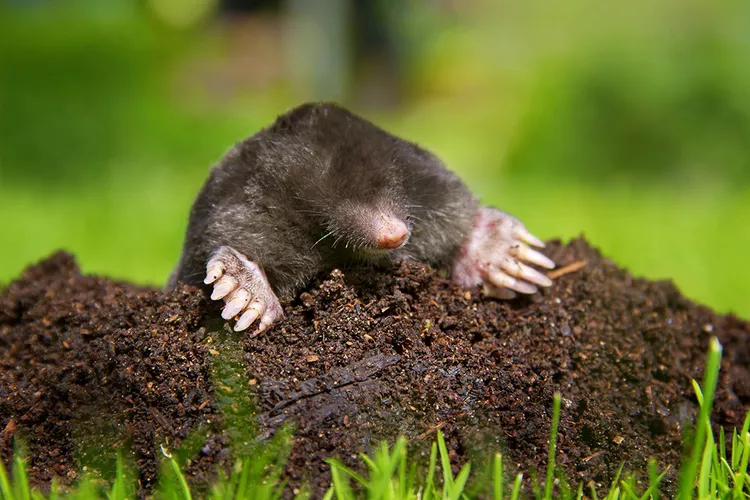
Moles have black or gray fur and a prominent, hairless snout. Their eyes are very small and buried in fur that they are almost invisible. Their front claws are large and hairless, designed for digging. Their ears are not visible.

Difference Between Moles, Voles, and Pocket Gophers

Homeowners sometimes mistake mole tunnels for those made by voles or pocket gophers, small rodents that also tunnel underground. Whereas moles leave prominent ridges above their tunnels in your lawn, capped off with distinctive volcano-shaped soil mounds, voles leave only subtle evidence of their tunnels in the landscape, if any. Their tunnels soften the soil, though, so it feels soft when you walk on it, and the small, flat, circular entrance holes to their tunnels are much more subtle than those of moles.

Pocket gophers don’t create prominent raised ridges as they go. Instead, they eat the roots of grass and other plants, pulling them down into underground burrows, which tends to push soil out to the side. Their tunnels look more flattened than mole tunnels, with fan-shaped or semicircular mounds. Each mound may contain a visible hole, although earth clumps can camouflage the hole.

If you happen to see one of these creatures, you might be able to identify it by size. At 4–7 inches long, a mole is smaller than a pocket gopher but larger than a vole.

How to Get Rid of Moles

Spring and fall, when the ground is not frozen, are the best times of the year for getting rid of moles because that’s when they’re most active. You likely have only one or two moles to trap to solve the problem because they don’t live in groups.

Humane Solutions

Remove the food source. The most humane way to get rid of moles is to use beneficial nematodes that dine on the grubs that form much of the mole diet. Without their favorite food source, moles tend to move on. This organic pesticide can be used safely around children and pets.

Put out a live trap. You’ll need to find an active tunnel for the trap. To identify an active tunnel, flatten it by stepping on it and checking it the next day to see if it is no longer flat, meaning a mole has passed that way. Install the live trap. following the product directions. Check the trap daily, or the animal might die while confined. Take it far away from your yard and release it.

Use a repellant. A safe liquid repellent frequently contains castor oil, which disturbs the natural eating patterns of moles, causing them to leave the area. Granular repellant with castor oil works the same way.

Not all repellants are child- and pet-safe. Confirm a repellent or deterrent is safe to be around your family and animals before buying it.

Lethal Solutions

Figuring out how to get rid of moles can be tricky because they live underground. Poisons and fumigants are options but should be avoided if you have pets or children that may be exposed.

The only sure way to eliminate a mole is to use a mole-specific trap that kills the animal. You can find below- and above-ground traps in several designs to do the job. Follow the package directions for correct placement, and move the tunnel traps daily while you still notice activity to increase your chances of eliminating the mole.

How to Keep Moles Away

After you get rid of moles, use one or more of these methods to keep them away.

Plant flowers moles hate: Moles dislike the scents of marigolds, daffodils, and alliums, so planting these in a garden bed discourages moles while providing a colorful addition to your yard.

Go techy with ultrasound: Install ultrasonic mole-repellent devices. These devices emit an ultrasound that drives moles away without any chemicals. They are low-maintenance (some are solar-powered) and safe to use around people and pets.

Spread a deterrent: Make your yard inhospitable by sprinkling a child- and pet-safe granular deterrent around the yard.

Improve yard drainage: Because moles prefer to live in areas where the soil stays moist, improving the drainage on your property might discourage them.

Use barriers: If you frequently have moles around and don’t mind a few tunnels around your property, try the barrier method to protect small spaces, like a veggie garden or a colorful flower bed in your front yard. Create an underground fence by burying a 24-inch metal or hardware cloth barrier at least a foot below the surface. If a mole tunnels into this barrier, it usually moves on and digs elsewhere.

Frequently Asked Questions

  • Will moles eventually leave on their own?

    Moles will leave on their own only when their food source runs out. Otherwise, they’re likely to stick around unless the homeowner takes some action.

  • What’s the best way to repair mole damage to your yard?

    If you still have moles, flatten the runways they create underground using a lawn roller or stomping them with your feet. You can also rake out their tunnels. After they’re gone, fill the holes with topsoil and add sod or seed for new growth.

  • Do home remedies like vinegar work to get rid of moles?

    Some homeowners have had success applying a mixture of one part vinegar to three parts water in a spray bottle to the holes and tunnels and reapplying it every few days. Be careful using vinegar because it can kill surrounding plants.

  • Is it OK to leave moles in your yard?

    Although they leave unattractive tunnels and weak spots in the yard, they also provide some benefits. They eat grubs, beetles, ants, snails, and termites. They also aerate and fertilize the soil.

Related Article

How to Make a Spherical Hanging Basket in Just 20 Minutes
30.4K
3K
1.3K

How to Make a Spherical Hanging Basket in Just 20 Minutes

Create a sphere hanging basket to show off your flowers in just 20 minutes with these easy instructions.
How to Make an Adorable Well for Your Fairy Garden
6.8K
547
175

How to Make an Adorable Well for Your Fairy Garden

Add a touch of charm to your fairy garden with this DIY well, complete with a tiny basket. Follow these step-by-step directions and images to make your minature fairy well magical.
Easy 4-Step DIY Paver Planter Box
40.2K
2.4K
626

Easy 4-Step DIY Paver Planter Box

Skip the store-bought concrete containers and instead make your own with this easy DIY planter roject.
What Is an Olla Pot? Plus 10 Tips for Efficiently Watering Plants with It
1.4K
67
22

What Is an Olla Pot? Plus 10 Tips for Efficiently Watering Plants with It

Olla pots simplify plant watering and reduce water waste. Here's how to make a DIY olla pot and 10 tips for using it for efficient watering.
Got Lots of Dandelions? Here's What Your Lawn Is Trying to Tell You
20K
1K
230

Got Lots of Dandelions? Here's What Your Lawn Is Trying to Tell You

Dandelions will quickly take over a lawn that needs help. Learn how to discourage them from taking root with these lawn care tips.
5 Smart Tips for Protecting Shrubs from Winter Damage
34.8K
347
170

5 Smart Tips for Protecting Shrubs from Winter Damage

Help your shrubs survive the winter with these tips on how to protect them from damage due to harsh weather and hungry critters.
Yes, You Can Grow Magnolia Trees in Pots—Here’s How to Succeed
25.2K
1.8K
776

Yes, You Can Grow Magnolia Trees in Pots—Here’s How to Succeed

With a big planter and a small variety, here’s how to grow a magnolia in a pot.
How to Plant and Grow Glossy Abelia
43.4K
3.5K
346

How to Plant and Grow Glossy Abelia

This guide on how to grow glossy abelia includes essential planting and care tips such watering, fertilizing, and pruning needs. You'll also find popular types of abelia to grow and pretty companion plants for this flowering shrub.
Top Plants for Florida Landscaping and Gardens
30.2K
2.7K
679

Top Plants for Florida Landscaping and Gardens

The tropical environment means top plants for Florida will thrive and grow, adding lush, green bulbs, trees and perennials to landscapes and gardens.
15 Super Plants for Texas Landscapes
43.8K
3.9K
1.2K

15 Super Plants for Texas Landscapes

These plants are superstars in Texas gardens and landscapes. Experts recommend them for their ability to thrive in south-central climates.
How to Plant and Grow Purple Poppy Mallow
31.3K
625
100

How to Plant and Grow Purple Poppy Mallow

Also called winecup, purple poppy mallow thrives in sunny spots.
How Long Does It Take for Sunflowers to Grow from Seed?
3.7K
295
112

How Long Does It Take for Sunflowers to Grow from Seed?

How long does it take for sunflowers to grow from seed? It varies. This guide covers harvest times for microgreens, cut flowers, and edible seeds.
How to Build a Broken Brick Patio
30K
1.2K
323

How to Build a Broken Brick Patio

With simple tools and no masonry experience, you can turn a pile of old broken bricks into a handsome patio or garden path.
How to Grow and Care for a Coffee Plant Indoors
21K
840
386

How to Grow and Care for a Coffee Plant Indoors

Learn how to grow a coffee plant indoors, including tips on light, humidity, watering, and pot size. This houseplant will add a tropical touch to your home with its glossy green leaves.
Should You Use Japanese Beetle Traps? Here’s What Experts Say
8.6K
516
87

Should You Use Japanese Beetle Traps? Here’s What Experts Say

When used incorrectly, Japanese beetle traps can make your garden worse. Learn other ways to keep these pests away.
How to Grow Ginger Root Indoors in 4 Simple Steps
33.6K
1.7K
521

How to Grow Ginger Root Indoors in 4 Simple Steps

Use this guide to grow a ginger root into a new plant and harvest more ginger.
10 Best Tomato Companion Plants to Grow
26.7K
2.1K
1K

10 Best Tomato Companion Plants to Grow

Keep tomato hornworms and other common tomato pests away with the help of companion planting. From basil to sunflowers, these top tomato companion plants include herbs, vegetables, and flowers that help discourage pests.
Brighten Up Small Spaces with This Corner of Perennials Garden Plan
43.3K
1.3K
182

Brighten Up Small Spaces with This Corner of Perennials Garden Plan

Create a colorful nook with this corner of perennials garden plan, which includes a simple arrangement of easy-care, flowering plants.
What is a Sensory Garden? Plus 3 Expert Tips on How to Create One
29.5K
295
144

What is a Sensory Garden? Plus 3 Expert Tips on How to Create One

Plant a garden that engages your five senses (sight, sound, smell, touch, and taste). This explains what a sensory garden is and provides tips for creating your own.
Grow Perfect Tomatoes with This PVC Trellis
25.6K
2.6K
383

Grow Perfect Tomatoes with This PVC Trellis

Protect your homegrown produce and learn how to make an arbor made with PVC pipes. This easy project is much less expensive than store-bought options!