
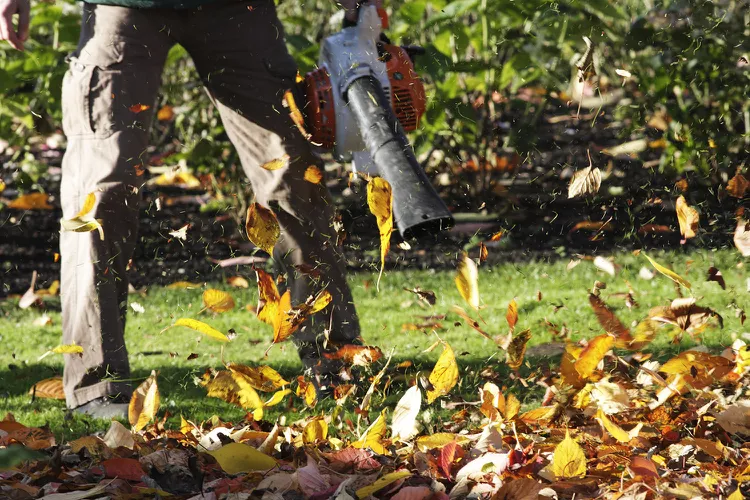
Whether you need to clean off the sidewalk after mowing or gather up fall leaves, leaf blowers are an efficient tool that can get the job done fast. These machines come in a variety of shapes and sizes that can fit nearly any homeowner’s needs. And thanks to new innovations, leaf blower models are increasingly quiet, which can go a long way towards staying in your neighbors' good graces. This simple guide will help you to choose and use a leaf blower safely and accurately.
Types of Leaf Blowers
As technology has advanced, several types of leaf blowers have been developed from gas-powered backpack units to hand-held battery-powered blowers. Before buying a leaf blower, it's worth carefully considering the features that are important to you so that you get the best model for your needs.
Gas-Powered: There are two kinds of gas-powered leaf blowers: the hand-held and the backpack. Both types of gas-powered leaf blowers provide substantial power and capability from 2-stroke engines. Handhelds tend to be easy to handle for most users while backpack units are often substantially heavier, but more powerful. For excellent performance and multi-use capability, some models provide blower, vacuum, and leaf mulcher all in one, significantly easing the workload of maintaining larger landscapes.
Electric: This kind of leaf blower functions in a similar way as gas-powered machines, but plugs in or uses a battery pack as its power source. Generally weighing less and slightly more maneuverable, electric leaf blowers offer adjustable power, but in the case of battery-powered models, they can have a shorter run time. Electric blowers are great for smaller yards where quieter machines are preferred and range issues aren’t as important.
Leaf Blower Safety
As with all equipment, safety gear is highly recommended while using your leaf blower. Safety glasses or goggles, gloves, and ear protection are beneficial for users of both gas-powered and electric units. Additionally, pants, long-sleeved shirts, and closed-toe shoes will help protect you from flying debris.
How to Properly Use a Leaf Blower
Using a leaf blower correctly requires a bit of technique. And for best results, this task should be done during calm, dry weather when leaves, dust, and other debris can easily be blown in a single direction. Follow these three easy steps to use your leaf blower:
Step 1: Identify "Leaf Traps"
Before starting up your leaf blower, take a few minutes to walk the area you’ll be working and identify where most leaves have naturally gathered. These “leaf traps” could include storm drains and around shrubs or tall ornamental grasses.
Step 2: Choose a Starting Point
With your leaf blower held to your side, identify a location around the perimeter of the yard to begin. Standing there, start blowing leaves into a central, open space. Use bursts of air to move leaves around and resist using a “full-throttle” approach. Point the blower toward the ground directly in front of you and sway the blower back and forth in a “U” shape, gathering leaves as you move across the yard.
Step 3: Gather Leaves into Piles
As you move toward the center of the yard, gather leaves into small piles rather than one large pile, which can be more difficult to clean up and will smother grass or other plants if left for more than a few days at a time.
What to Do with Leaf Piles
Once leaves have been piled together, you have multiple options for removal.
Mulch: Leaves provide an excellent source of nutrients, habitat, and natural weed suppression and can be sprinkled around garden beds in late fall. In most areas that receive plenty of rain and snow, a 4-5” layer of leaves will biodegrade into the soil within a single season.
Compost: Another option for your collected leaves is to compost them. As with mulching, fallen leaves make excellent compost that can later be used to improve garden soils.
Fall Decoration Filler: In lieu of bagging and disposal, leaves can also be used as filler for fall decorations. Halloween leaf bags come in a wide variety of sizes and designs making them a good fit for most yards.
Disposal: If none of the previous options will work, proper disposal of leaves is important! Most cities and towns discourage blowing leaves into the streets or gutters as they can clog storm water drains and their decomposition can lead to river and stream water quality issues. Always contact your municipal waste hauler or city government to find out the best way to dispose of leaves.
With the help of leaf blowers, taking care of fallen leaves and other maintenance tasks can become much easier once you know how to use them effectively.