
Even if you've been saving inspiration images of raised bed gardens for months, coming up with a raised bed layout for your own space requires both aesthetic and practical considerations. "Designing a raised bed garden is so different from other parts of they landscape, because you're going to be working in it all the time," says garden designer Nicole Burke. We talked to Burke and other experts about how to configure raised beds to maximize both bounty and beauty in your yard.
- Leslie Bennett is a landscape designer and founder of Pine House Edible Gardens and Black Sanctuary Gardens in Oakland, California.
- Nicole Burke is a landscape designer, garden consultant, and founder of Gardenary in Nashville, Tennessee.
- Holly Kuljian is landscape architect at Pine House Edible Gardens in Oakland, California.
- Patrick Metz is the product director at Gardeners.com.
Best Raised Bed Garden Layouts for Different Spaces
The best raised bed garden layout is one that fits your particular space, as well as your garden goals, especially if you're new to gardening. "If you're interested in growing food and flowers more for the experience than for self-sufficiency, plan for one or two raised beds," says landscape designer Leslie Bennett. If you're more ambitious, the more beds, the merrier. Our experts share their favorite ways to configure raised beds for various situations.
1. All in a Row
If you're tight on space, line up raised beds along the perimeter of your yard or driveway. In this garden designed by Bennett and landscape architect Holly Kuljian, the veggie beds were placed along a long narrow side yard. "The beds are a comfortable 24-inch height for working, with a wide lip on the edge for sitting or placing tools," says Bennett. These beds are smartly placed for easy access, notes Kuljian: “The central break in the beds aligns with the main staircase to the patio, which creates such a nice flow from the house down into the garden."
2. Two of a Kind
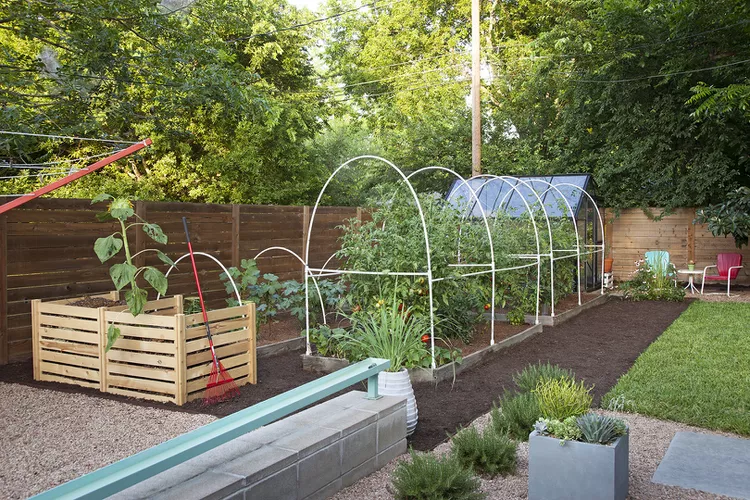
This "twin garden" designed by Burke is an example of one of the most popular raised garden layouts among her clients. Leave enough room for a path between the beds and join them by a trellis so "you end up with a magical walk between them," says Burke. She likes to plant symmetrically, mirroring the crops planted in one bed in the other. "It's aesthetically pleasing, but also helps minimize disease because you're not planting only one type of crop in one place."
3. Trio of Beds
Anything in threes is satisfying visually, plus "a trio of raised beds works really well if you have a circular or curved space," says Burke, who designed this raised bed garden. She likes to mirror the planting combinations in the two outside beds, and then dedicate the center bed to something else—perennials or cutting flowers, for example. Adding trellises to each raised bed helps define the space.
4. Courtyard Setup
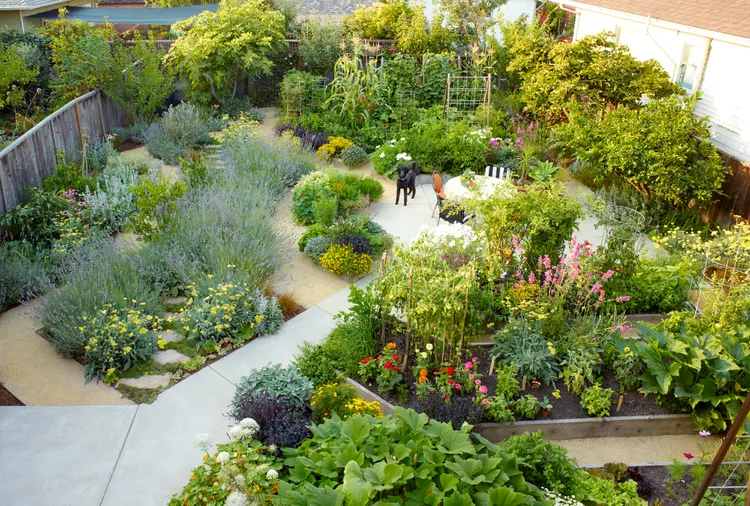
Raised beds can also be placed around a central courtyard or another focal point like a fountain, like in this backyard planted by the Pine House Edible Gardens team. "We designed around the existing concrete patio to highlight the central gathering space," says Bennett. "It gives a sense of place and really immerses you in the garden to table experience.” Because beds can be accessed from both sides, says Kuljian, the team designed them slightly wider (4-5 feet) to maximize production.
5. Four Square
If you have enough space and want to make your raised bed garden feel like a destination, opt for four beds of the same size, says Burke. As in this garden she designed, she likes to connect the beds on each side with arched trellises. "That way you can create a grand entrance and clear exit," she says. The idea is to essentially double what you'd do in a twin garden, but "with four beds, you create more of a designated space."
Choosing a Location for Your Raised Beds
Before you start building any raised beds or click "Buy" for pre-made ones, you need to figure out where you're going to put them. Here are the top factors that go into choosing a spot:
Sunlight
If, like most people, you plan to grow edibles, annual and perennial flowers, or both in your raised beds, look to the sun when determining the best spot for your beds: Most popular vegetables and cutting flowers need full sun (6-8 hours of exposure) to thrive. That said, there are plenty of crops that don't mind less than that if you can find a spot that's entirely full sun.
"If a tree is going to block one corner of your raised beds, that’s where you might plant anything that likes a break from the sun, like lettuces and kale," says Patrick Metz of Gardener's Supply Company.
Soil
A big upside of raised beds is the ability to control the quality of the soil. Even so, your native soil may be a consideration when you're thinking about a raised bed layout. "The type of soil you have affects where you put your beds as well as the height of beds," explains Metz.
Ideally, you'd put your raised beds in a spot where the soil drains well, since plants with longer roots may be reaching deeper than your bed. If the best light is in a spot where your soil is clay and doesn't drain well, however, you can still put your raised beds there—just choose deeper ones and fill with well-draining soil.
Pathways
When choosing a spot for your raised beds, allot a certain amount of workable space around them. "The main access paths to your raised beds should be at least 3 feet wide so you have space to move around, work the soil, and get a wheelbarrow to the beds if needed," writes Bennett in her book, Garden Wonderland. If you have room, she says that a wider path "can feel more inviting and encourage more frequent interaction with your garden." If you are very short on space, your pathway width can be as little as 18 to 30 inches on the back side of each bed, which will be enough to get your body through for less regular harvests and basic cleanup.
If you are going to be harvesting from only one side of a raised bed, it should be no wider than 3 feet; if you'll be able to reach it from both sides, you can go up to 4 feet wide or so. To make harvesting easier on your back and knees, go for a bed that's 2 feet tall or higher.
How to Mock Up a Raised Bed Layout
Once you've picked your spot and have a raised bed layout in mind, start mapping it out before you commit. "Put a couple of weeks into playing with the space in your mind," recommends Metz. "I don’t think a clear-cut layout always jumps off."
To plot out different scenarios, recommends Metz, start with a loose sketch, or, if you want to be precise, a to-scale drawing on grid paper. "Google Maps can also be a good way to get an overview of your space," he says.
Then take your visions outside. "You can use stake and string to try out different configurations," says Burke. Another trick of hers: Use sheets folded up to the size of beds you're thinking about, placing them around the yard in different ways. "It's different from string, because it will help you envision what the yard will feel like when that space is consumed by raised beds."