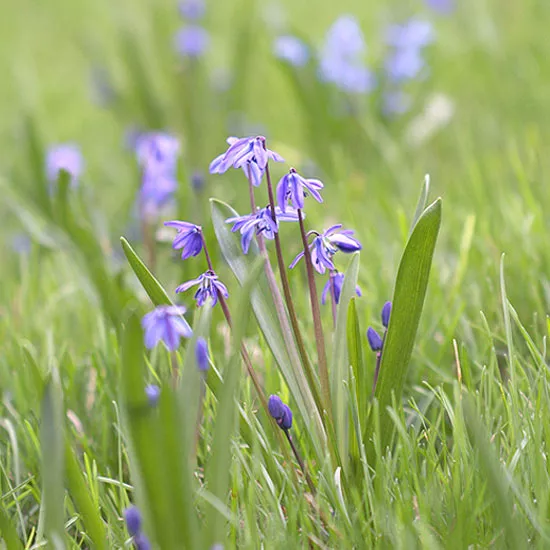
Squill or Siberian squill, also referred to by its botanical name, Scilla, is a spring bulb that announces a new garden season with bursts of dark green grass-like foliage. The leaves seem to emerge overnight in early spring. The tufts of foliage are quickly followed by arching flower stalks that support one to three nodding blue or white flowers. These tiny blossoms with a sweet fragrance decorate the garden for two to three weeks and, when planted in large masses, catch the eye from a distance.
The flowers provide a welcome early-season nectar source for bees. Squill is toxic to humans.
Squill Overview
| Genus Name | Scilla sibirica |
| Common Name | Squill |
| Plant Type | Bulb |
| Light | Part Sun, Sun |
| Height | 3 to 6 inches |
| Width | 3 to 6 inches |
| Flower Color | Blue, White |
| Foliage Color | Blue/Green |
| Season Features | Spring Bloom |
| Special Features | Fragrance, Low Maintenance |
| Zones | 3, 4, 5, 6, 7, 8 |
| Propagation | Division |
| Problem Solvers | Deer Resistant |
Where to Plant Squill
Squill thrives in locations with light shade or dappled shade and well-drained soil with a neutral pH. The areas below deciduous trees and shrubs and around the base of perennials are ideal planting locations for squill because the bulbs complete their life cycle before the larger plants leaf out and limit their sunlight.
For the most eye-pleasing effect, plant squill in drifts of no fewer than 100 bulbs. Plant bulbs along walkways, interspersed with perennials, and in herb or rock gardens.
How and When to Plant Squill
Squill, like most spring bulbs, are planted in fall as soon as the soil has cooled down to around 55 degrees F, which is usually the case after the first couple of fall frosts.
Plant squill bulbs with the pointed growing tip facing upward. Plant bulbs so the base of the bulb sits 5 inches deep in the soil. Space bulbs 2 inches apart, or plant 20 bulbs per square foot. Water the bulbs after planting and again in late fall if there is no rain.
Squill Care Tips
Squill are low-maintenance perennials that will add color to your spring garden for many years to come.
Light
Select a location that provides light shade or dappled sunlight after surrounding trees and shrubs leaf out.
Soil and Water
The soil should be well-drained, with a pH around 7.0. Sandy loam is ideal. Like all flower bulbs, squill will do poorly in heavy, dense soil with high clay content and poor drainage.
Temperature and Humidity
Squill is a very hardy plant that withstands winter temperatures as low as Zone 3. On the other hand, summers above Zone 8 are too hot and winters too mild to grow them.
The bulbs have no humidity requirements; by the time the summer weather turns humid, they have entered their summer dormancy so the foliage won’t be affected by humid weather.
Fertilizer
There is usually no need to fertilize squill. At the most, apply a low-nitrogen, high-phosphorus bulb or granular fertilizer when the foliage emerges.
Pruning
After the bloom, the foliage directs energy into the bulb for the following season; it's important to let the foliage stand until it begins to show signs of dormancy. Leave the foliage in place until it begins to turn yellow and wither. If you planted squill in an area that you typically mow, delay the first mowing of the season. For the first mowing, set the mowing height to at least 4 inches to limit the damage to individual squill leaves that have not yet reached dormancy.
Potting and Repotting Squill
It is not recommended to grow squill in containers unless it is to force them for early blooming. When grown as perennials, the bulbs need consistently cold winter temperatures to develop good root systems and grow foliage and flowers in the spring. In pots, unlike in garden soil, the bulbs are exposed to significant temperature fluctuations and cycles of freezing and thawing, which harm the bulbs.
Pests and Problems
Squill is free of serious pests or diseases. Deer and rodents show no interest in it.
How to Propagate Squill
Squill readily multiplies on its own, either through bulb offsets or ants carrying the seeds (that's why you might find squill in faraway corners of your yard).
The common method to propagate squill is by division when the patches get too crowded. As the foliage dies back after the bloom, mark the location so you know where to dig the bulbs in the fall. Use a shovel to dig up the bulbs. Discard any dead and damaged bulbs and replant the remainder in a new location as described under How and When to Plant Squill.
Types of Squill
Scilla siberica ‘Spring Beauty’
This cultivar is the most popular squill. It is slightly larger than the species, longer blooming, and the flowers are deeper blue. Zone 3-8
Scilla siberica alba
The white variety of Scilla siberica has loosely formed, bell-shaped flowers on 3- to 5-inch stems. Zone 3-8
Scilla bifolia rosea
Also known as alpine squill, this early-blooming squill has soft pink, lightly scented flowers, Zone 4-8
Scilla mischtschenkoana
Multiple (up to four) flower stems with show light bluish-white flowers set this scilla species apart. It was formerly known as Scilla tubergeniana. Zone 4-8
Squill Companion Plants
Crocus
When crocuses pop out of the ground, sometimes through snow, you know winter is coming to an end. Large sections of the petite, ground-hugging flowers planted beneath deciduous trees create a spectacular sight. This plant also possesses the power to jazz up rock gardens, brighten the ground in front of shrubs, and line sidewalks with splashes of color. Zone 3-8
Creeping Phlox
Phlox subulata is a low-mounding variety of phlox that is covered with bright flowers in spring. It forms short, thick cushions of finely textured, stiff foliage. Because it seldom tops 6 inches in height, it fits in nicely with low-growing spring bulbs such as squill. Zone 3-8
Daffodils
For the earliest daffodils to brighten up the landscape with their golden-yellow blooms, choose 'Rijnveld's Early Sensation' or the early, miniature yellow 'Tete a Tete'. Daffodils are sturdy plants that bounce back even after late snow showers. Once you have planted daffodils, they'll return year after year and even multiply with minimal care. Zone 3-8