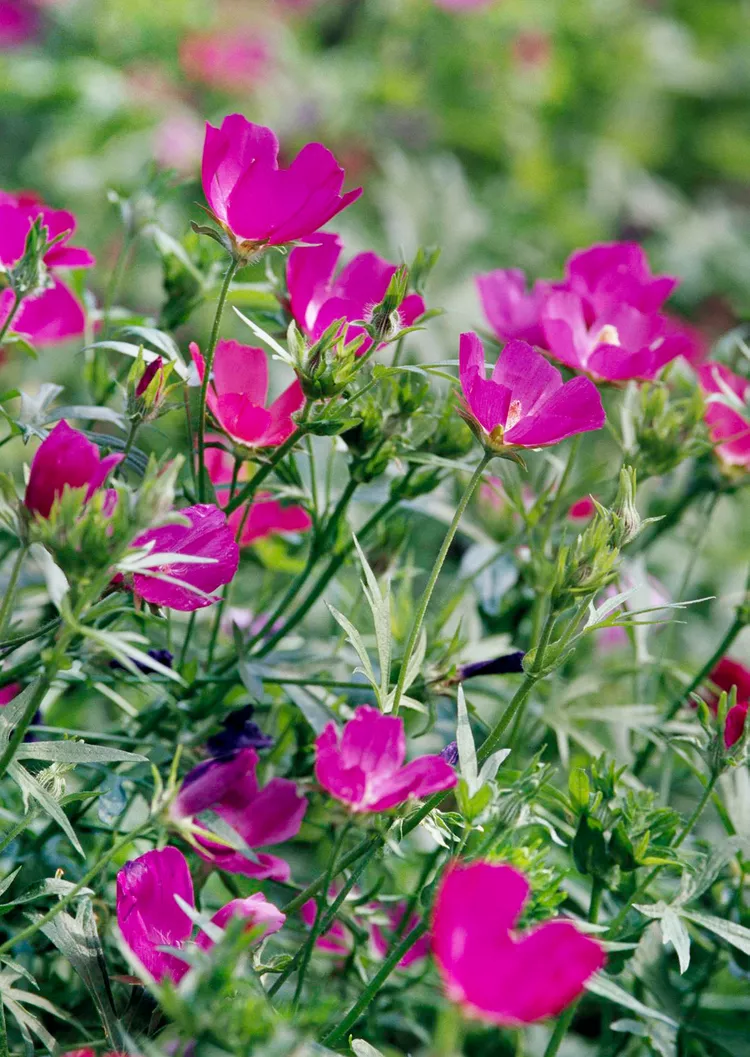
Purple poppy mallow (Callirhoe spp.) is a native perennial plant with a long bloom period. The curve of the overlapping petals forms each flower into a pinkish-purple cup, so it is no surprise this plant also goes by the moniker "winecup." The flowers open each day and close at night.
Purple poppy mallow grows wild in dry, rocky areas, such as prairies, pastures, open woods, and roadsides in the central and southern Great Plains. This perennial attracts pollinators and offers the desirable features of deer resistance, drought tolerance, and low maintenance. It produces flowers along its sprawling stems, sometimes propped up by taller plants, creating appealing combinations in the garden.
Purple poppy mallow is a good choice for native habitat gardens, where it can be a host plant for the caterpillars of the gray hairstreak, checked skipper, and painted lady butterflies. A host plant provides habitat and food for insects.
Purple Poppy Mallow Overview
| Genus Name | Callirhoe |
| Common Name | Purple Poppy Mallow |
| Additional Common Names | Winecup, Buffalo Rose |
| Plant Type | Perennial |
| Light | Sun |
| Height | 6 to 48 inches |
| Width | 1 to 3 feet |
| Flower Color | Pink, Purple, White |
| Foliage Color | Blue/Green |
| Season Features | Fall Bloom, Spring Bloom, Summer Bloom |
| Special Features | Attracts Birds, Low Maintenance |
| Zones | 4, 5, 6, 7, 8, 9 |
| Propagation | Seed, Stem Cuttings |
| Problem Solvers | Deer Resistant, Drought Tolerant |
Where to Plant Purple Poppy Mallow
Plant purple poppy mallow in USDA Hardiness Zones 4-9. Use it in sunny rock gardens, trailing over a wall, garden beds, and native habitat gardens. Shorter varieties are excellent groundcovers. Use rocks or small boulders around the plants similar to their natural environment.
How and When to Plant Purple Poppy Mallow
Purple poppy mallow is a hardy perennial that can be planted whenever the ground is workable and the plants are available. Water the pots and allow them to drain before planting purple poppy mallow transplant purchased from a garden center or online nursery. Soil amendments are not needed but loosening the soil with a spade or garden fork will make it easier for the new roots to grow outward.
As an alternative to buying plants and transplanting them, sow seed in a prepared garden bed in late summer or early fall. Cover them with 1/8 inch of soil and space them 18–24 inches apart, or follow the spacing instructions listed on the seed packet. It can take up to six months for the plants to germinate. Sow the seed where you want the plants; they don't transplant well because of their long taproots.
Purple Poppy Mallow Care Tips
Light
Choose a spot in full sun—the brighter, the better. In extremely hot areas, a little afternoon shade benefits the plant.
Soil and Water
Place purple poppy mallow plants 2-3 feet apart in well-drained garden soil with medium moisture. The preferred pH range is mildly acidic—a pH of 6.0 to 6.5 is ideal. Provide supplemental water for the first year to help the plant get established. Watering after the first year is unnecessary.
Temperature and Humidity
The best summer temperature range for this warmth-loving plant is 50°F to 80°F. This mat-forming perennial is hardy in Zones 4-9, depending on the variety, and dies back to a low rosette in winter in most areas.
Fertilizer
Fertilization is not necessary. Purple poppy mallow tolerates poor, infertile soil.
Pruning
No pruning is needed. Prolong flowering by deadheading, although this is not necessary for a healthy plant. Cut back the stems by half when they become rangy (long without many leaves).
Potting and Repotting Purple Poppy Mallow
Purple poppy mallow grows well in containers and hanging baskets as long as the containers offer excellent drainage and are filled with well-draining potting soil. They flourish in full sun, but when the temperature is very hot, move the containers to an area with some shade.
Because the plant has a long taproot, it is difficult to transplant successfully, so repotting is not always successful.
Pests and Problems
Purple poppy mallow has few pest problems. Root rot may occur in poorly drained soils; this plant likes dry soil. Slugs may visit the plants. Protect young plants from hungry rabbits with a fence or repellent.
How to Propagate Purple Poppy Mallow
The plant does not divide well because of the long tap root, but you can propagate via seed or stem cuttings.
Seed:
Harvest seed from purple poppy mallow plants at the end of the growing season after the blooms have died. Remove the ripe seed heads and put them in a paper bag. Shake the bag to separate the seed from the chaff. Store the seeds in a cool, dry place.
If you are sowing directly into a prepared bed in the fall, no cold stratification is necessary; winter will take care of that. However, if you plan to start the seeds inside in spring, they must go through a cold, moist stratification period. Place the seeds in a plastic bag with moist, sterile soilless mix. Put the sealed bag in the refrigerator for two to three months.
For the best germination rate, scarify the seeds with sandpaper to abrade the tough outer coat of the seeds. Then, plant them 1/8 inch deep in small pots filled with well-draining potting soil. Place the pots in a warm location, and keep the planting medium moist but not wet. Germination may take months. When the seedlings reach 4 inches tall, they can be transplanted into the garden or a container.
Cuttings:
Take stem cuttings from an established purple poppy mallow plant. Remove any foliage from the bottom half of each cutting and dip it in rooting hormone. Insert each cutting into a small pot filled with sand or a sterile potting mix. Excellent drainage is essential. Place the pots in a warm, brightly lit location. When new growth appears, the cutting has rooted. When the root system is robust, transplant the plants to a garden bed or container.
Types of Poppy Mallow
Mexican Winecup
Mexican winecup (Callirhoe involucrata var. tenuissima) is native to high elevations and has a lavender-purple flower. The branches of this 6-inch tall groundcover spread to 3 feet. Zones 4–9.
Fringed Poppy Mallow
Fringed poppy mallow, also called standing winecup (Callirhoe digitata), is upright and reaches 3-4 feet tall. Its petals are fringed along the outer edge, and its leaves are finely divided. It is native to a small area of the lower Midwest and eastern Great Plains. Zones 5–8
'Logan Calhoun'
Pale poppy mallow (Callirhoe alcaeoides) is native from Illinois to Nebraska and south to Alabama and Texas. It has white, rose, or lavender flowers surrounded by leaves with narrow lobes. The variety 'Logan Calhoun' has pure white flowers on 12 to 20-inch plants. Zones 4–8.
Bush's Poppy Mallow
Bush’s poppy mallow (Callirhoe bushii) is highly drought-tolerant and native in dry areas of Arkansas, Missouri (Ozark Highlands), Oklahoma, and Kansas. It grows 18 to 30 inches tall and is upright. Zones 4–8.
Purple Poppy Mallow Companion Plants
Prairie Dropseed
Prairie dropseed grows in full sun and delivers a hint of prairie to the garden. Its leaves turn gold or orange in fall and copper-brown in winter. Flower panicles appear in late summer. This easy-to-care-for ornamental grass attracts pollinators and birds.
Butterfly Weed
Butterfly weed (Asclepias tuberosa) delivers a complementary orange color that overlaps the purple poppy mallow bloom time. Plants in the Asclepias genus provide food for the larvae (caterpillars) of the monarch butterfly. This small to medium-sized prairie plant works well in perennial gardens.
Nodding Onion
The short native nodding wild onion (Allium cernuum) with a pale pink flower makes a lovely combination with purple poppy mallow. It blooms with pink flowers on 2-foot-tall stems.