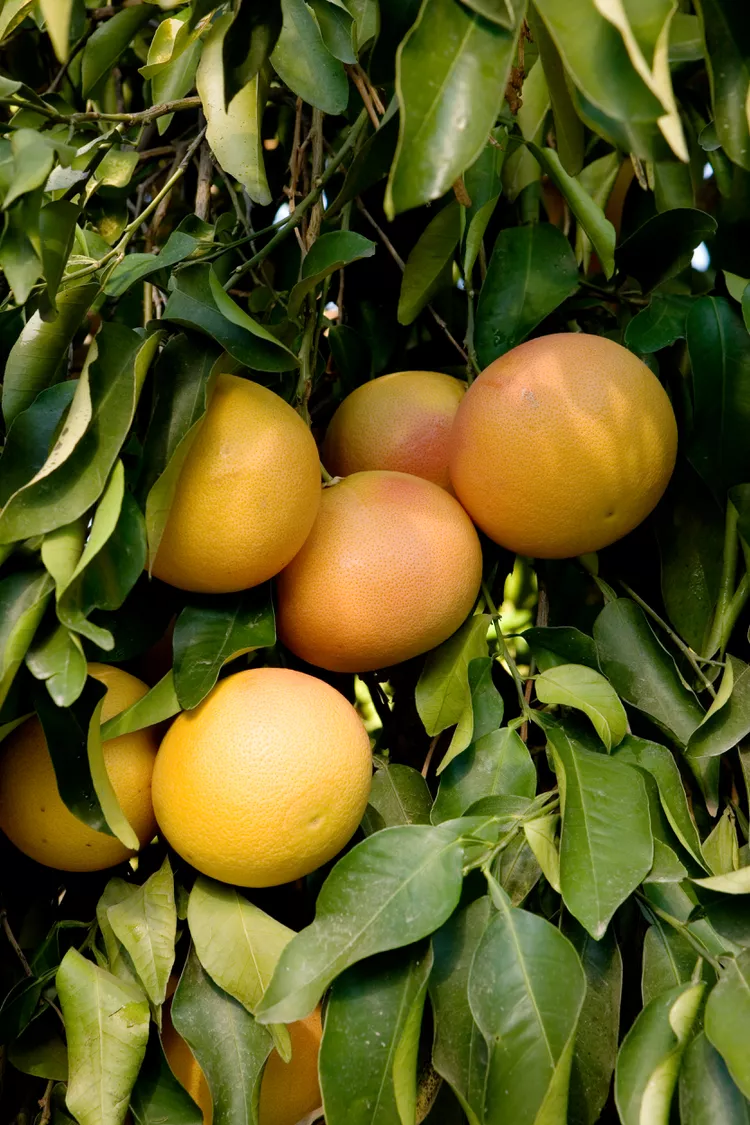
An easy-care and long-lived backyard tree, a grapefruit tree (Citrus x paradisi) is prized for its productivity. A mature tree—grapefruit trees usually reach maturity at about five years of age—potentially produces more than 200 pounds of juicy, sweet-tart, crimson fruit. Ripening in October through January, grapefruit becomes sweeter as it remains on the tree.
Here's how to plant and grow your own grapefruit tree.
Grapefruit Overview
| Genus Name | Citrus spp. |
| Common Name | Grapefruit |
| Plant Type | Fruit, Tree |
| Light | Sun |
| Height | 12 to 25 feet |
| Width | 10 to 15 feet |
| Foliage Color | Blue/Green |
| Zones | 10, 11, 9 |
| Propagation | Grafting, Stem Cuttings |
Always purchase grapefruit trees (like all citrus trees) from a certified nursery that has been inspected by state or federal inspectors to ensure disease-free stock. Citrus is plagued by an incurable bacteria disease called Huanglongbing (HLB). The disease is rampant, and disease-free plant material is essential for fruit production.
Where to Plant a Grapefruit Tree
Grapefruit grows best in full sun. Direct sunlight is essential for fruit set. Choose a planting location that has at least eight hours of direct sunlight a day. Avoid planting near the north or east side of buildings or trees that could cast a shadow on the grapefruit tree. If freezing temperatures are the norm every few years, choose a location on the south side of a building for some potential protection. Choose a planting location that will accommodate the tree at maturity—grapefruit trees grow to 10–15 feet wide and 20-25 feet tall.
Grapefruit trees grow best in loose, well-drained soil. They do not tolerate slow-draining, heavy soil. Long periods in moist, clay and clay-like soil will quickly kill a grapefruit tree. The best soil for grapefruit trees is somewhat sandy in texture and with the ability to clump when moist.
How and When to Plant a Grapefruit Tree
Plant container-grown grapefruit trees any time of the year, but spring and fall are preferred thanks to the prevailing moderate temperatures. Plant a grapefruit tree when you have time to water it regularly for about two months. Bare-root trees are best planted in February or March.
Dig a planting hole as large as the young tree’s root ball. Take time to get the depth of the planting hole correct. When placed in the planting hole, the tree’s root flair, and the swollen area where the roots emerge from the trunk should be slightly above the soil line. Gently remove some soil from the outer edges of the rootball to expose roots, encouraging them to expand into the native soil. Backfill the planting hole with native soil.
After planting, if the soil drains freely, build a 5-inch-tall soil basin around the edge of the rootball area. This basin will capture water when the tree is young and deliver it to the plant’s root zone.
Grapefruit Tree Care Tips
Light
Grapefruit trees grow best when they receive at least eight hours of direct sunlight a day. Grapefruit trees grow in part shade, but fruiting is reduced significantly.
Soil and Water
Grapefruit trees thrive in well-drained, loose soil. They languish in heavy soil, such as clay. Sandy soil is preferred over soggy or frequently moist soil. Choose a planting spot with fast-draining soil for a long-lived tree.
Plan to water a newly planted tree every few days, slowly delivering about five gallons of water to the root zone. Keep up the regular watering for about two months, at which time the young tree should be established. Water during extended dry spells as needed. Mature grapefruit trees rarely need supplemental watering.
Temperature and Humidity
Hardy in Zones 9 to 11, grapefruit trees are sensitive to freezing temperatures. A freeze likely eliminates fruit buds for the following season and kills entire branches or the tree itself. If a freeze is predicted, cover a young tree with a blanket or tarp, securing the edges of the cover to the ground. Mature trees are nearly impossible to protect from a freeze.
A healthy grapefruit tree thrives with humidity at a minimum of 50 percent.
Fertilizer
Young grapefruit trees benefit from fertilization, but it is not essential. Most grapefruit trees planted in the home landscape source their nutrient needs from the surrounding soil. If growth is slow or the soil is exceptionally sandy and lacking nutrients, fertilize with a complete fertilizer product labeled 6-6-6 or 8-8-8. Follow package directions for the timing of the application and quantity.
Pruning
Easy-care grapefruit trees do not need regular pruning. Simply prune to remove broken, crossing, or diseased branches as soon as they are noticed.
Potting and Repotting
Grapefruit trees can be planted in large containers that offer excellent drainage and are filled with well-draining, sandy potting soil. There is also a special citrus tree potting mix for purchase. However, full-size trees won't live long in a container, so opt for a small variety for the best success. Look for dwarf or semi-dwarf grapefruit tree varieties that mature at only 10 feet in the ground and 6 to 8 feet in pots, such as 'Cocktail', 'Oroblanco', 'Redblush', 'Rio Red', or 'Star Ruby'.
The container should be at least twice the height and width of the tree's rootball. Position the container outdoors in full sun and water it regularly.
Repotting of the tree only becomes necessary when the tree outgrows its container in about four to five years. Transplant the tree into a container about 2 inches larger than the current one. Fill it with fresh potting soil before transferring the tree to its new home.
Pests and Problems
The most significant threat to grapefruit trees—and all citrus trees—is Huanglongbing (HLB). An incurable bacterial disease, HLB has been responsible for the death of millions of citrus trees since 2005. The best defense is to purchase disease-free plants from a reputable nursery.
Many familiar garden pests are attracted to grapefruit trees, including aphids, whiteflies, scale, mites, and thrips, as well as the less-familiar citrus leaf minor. Most of these can be treated with insecticidal soap or neem oil.
How to Propagate a Grapefruit Tree
Most grapefruit trees are propagated by stem cuttings that are grafted onto hardy rootstock, which is not available to home gardeners in small quantities.
It is possible to take stem cuttings from a tree and use them to produce a seedling, but without the hardy rootstock, it will lack the vigor or disease resistance of the parent plant. If you still want to give it a try, take a 6-inch cutting from a young branch of the tree. Make the cut beneath a leaf node. Remove all foliage except the top two leaves. Dip the cutting in rooting hormone and insert it halfway into a pot filled with sand. Water the pot and put a plastic cover or bag over it. Place it in a shady area and mist it three times a week until new growth appears.
Note that many grapefruit tree cultivars are trademarked or patented and it is illegal to propagate them. Identify the variety of your tree before attempting to propagate it.
Harvesting
Grapefruit maturity varies by variety. Some varieties are ready to harvest as early as October, while others ripen in January. One thing is consistent across the varieties; grapefruit can remain on the tree for several weeks—or months, depending on the cultivar—with no reduction in the quality of the fruit. In fact, grapefruit become sweeter the longer they are on the tree.
For easy storage, leave fruit on the tree until you are ready to harvest, plucking all the fruit from the tree by spring.
Types of Grapefruit Trees
'Ruby Red'
Citrus x paradisi ‘Ruby Red’ has red flesh, few seeds and ripens in November, but it can stay on the tree until May.
'Pink Marsh'
Citrus x paradisi ‘Pink Marsh’ has pink flesh and ripens in December. It is seedless and juicy.
'Rio Red'
Citrus x paradisi ‘Rio Red’ is known for its large fruit and deep crimson flesh. It has few seeds and ripens in November.